Directed by Richard Fleischer | Starring Anthony Quinn
There are certain films that remain with us long after the credits have rolled. They transcend entertainment and become something deeply personal, returning to our thoughts over the years and revealing new depths with each subsequent viewing. For me, Richard Fleischer's 1961 epic Barabbas is one such film. It is not only my favorite Christian film ever made, but one of my favorite films of all time.
I've chosen to review this particular film because it is very near and dear to my heart. With the limited time I have to devote to writing reviews, I would like to focus primarily on works that I believe deserve to be shared and championed before a wider audience. There are so many wonderful, underappreciated examples of Christian media, and I hope that through The Lion Heart I might introduce readers to some of these overlooked treasures.
Barabbas is perhaps one of the finest examples. Released during the great era of biblical epics, alongside celebrated films such as The Ten Commandments (1956) and Ben-Hur (1959), Barabbas has largely flown under the radar compared to many of its contemporaries. I find this deeply unfortunate. I suspect that some of its more challenging moral and theological themes may have been difficult for portions of the Christian moviegoing audience of the early 1960s to embrace, although I cannot say for certain. What I do believe is that Christian audiences today may find even more to appreciate in this remarkable film.
Adapted from the novel by Nobel Prize-winning author Pär Lagerkvist, Barabbas takes a figure mentioned only briefly in the Gospels and imagines the life that followed his extraordinary release. What emerges is one of cinema's most compelling explorations of guilt, grace, and the gradual transformation of a human soul.
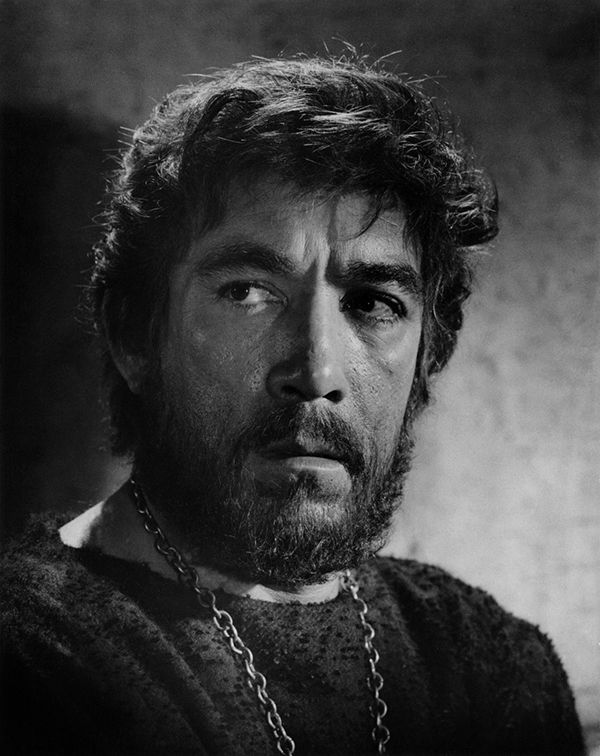
What makes the film so remarkable is that it refuses to approach its subject with the comforting simplicity so often associated with religious filmmaking. Barabbas is not a misunderstood hero, nor is he a fundamentally decent man merely awaiting an opportunity to demonstrate his goodness. He is violent, selfish, stubborn, and frequently cruel. Anthony Quinn delivers a towering performance, portraying a man who possesses immense physical strength but remains almost helpless before the spiritual questions that increasingly consume him.
And yet, from the moment Barabbas encounters Jesus Christ, something within him begins to change.
This transformation is neither immediate nor straightforward. Barabbas does not fall to his knees, proclaim his faith, and emerge as a new man. Indeed, for much of the film, he struggles even to acknowledge the possibility that Jesus was who his followers claimed him to be. Nevertheless, the encounter has left an unmistakable impression upon him. He cannot escape the memory of the innocent man who died in his place. He is haunted by it, troubled by it, and increasingly drawn toward the very faith he struggles to understand.
At the heart of the film lies a profoundly Christian paradox: Barabbas is a man who has literally been spared by the death of Jesus Christ, and who subsequently spends his life gradually coming to understand the significance of that salvation.
For Christians, the substitutionary nature of Christ's sacrifice is understood as a spiritual reality. Christ died in the place of sinners. Barabbas, however, experiences this exchange in the most immediate and physical sense imaginable. He was condemned to die, and another man took his place. He walks free while an innocent man is crucified.
Yet the significance of that exchange does not end at Golgotha. It follows him for the remainder of his life, slowly working upon his conscience and reshaping the man he will become.
Throughout the film, Barabbas encounters followers of Christ whose faith appears incomprehensible to him. Rachel, portrayed by Silvana Mangano, embodies a conviction he cannot initially understand. Sahak, played with tremendous dignity by Vittorio Gassman, possesses a spiritual freedom that Barabbas has never known, even when the two men share the same physical bondage.
His relationship with Sahak is particularly important because it allows us to witness the transformation of Barabbas through his actions rather than merely through his words. The brutal, self-centered criminal we meet at the beginning gradually becomes capable of genuine friendship, compassion, loyalty, and empathy. He comes to care deeply for another human being, even when that person's beliefs challenge his own.
These changes are not always dramatic. They emerge slowly through shared suffering, small acts of mercy, and moments in which Barabbas demonstrates a growing concern for others. His stubbornness remains, as does his difficulty understanding the Christian faith, but beneath these struggles a different man is taking shape.
This, I believe, is one of the film's greatest achievements. It recognizes that spiritual transformation is not always accompanied by an immediate or articulate profession of faith. Sometimes the evidence of a changing heart can be seen long before the person experiencing that change is willing or able to acknowledge it.
It is through these relationships that Barabbas develops one of its most compelling theological themes: the relationship between grace and faith, and the power of grace to transform a life over time.
Barabbas has been granted a life he did not deserve, and that gift becomes the defining event of his existence. He survives imprisonment, slavery, the sulfur mines, and the brutality of the gladiatorial arena. Again and again, death appears ready to claim him, and again and again he escapes.
But these experiences do not leave him unchanged. Each encounter with death, each act of faith he witnesses, and each relationship he develops brings him closer to understanding the man who once took his place upon the cross.
This is what elevates Barabbas beyond the familiar conventions of the biblical epic. Beneath its enormous sets, sweeping cinematography, and spectacular action sequences lies an intimate character study of a deeply troubled human being undergoing a gradual spiritual awakening. It is not principally a film about the establishment of Christianity or the grandeur of ancient Rome. It is about the transformation of one man's character through a lifetime spent wrestling with the implications of Christ's sacrifice.
The film is equally impressive in its unwillingness to portray this process as simple or effortless. Barabbas continues to doubt. He misunderstands the teachings of Christ. He sometimes returns to violence and allows his old instincts to govern his actions. But none of these failures erase the progress he has made.
There is something profoundly authentic about this portrayal. Spiritual growth is seldom a straight line. A man can struggle with doubt while nevertheless growing in faith. He can stumble while learning to walk. He can cling to old habits even as his heart is being transformed. Barabbas is never portrayed as a perfect man, but by the conclusion of the film, he is certainly no longer the man we first encountered.
Fleischer's direction complements this spiritual journey beautifully. The film's visual language is dominated by darkness, confinement, and occasional moments of overwhelming light. The infamous sulfur mines, where Barabbas spends years in bondage, become an almost physical manifestation of the suffering through which his character is shaped. The gladiatorial arena offers a different kind of imprisonment, one in which survival is purchased through violence and the destruction of others.
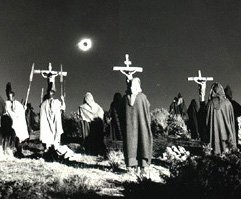
The Crucifixion sequence is particularly unforgettable. Filmed during an actual solar eclipse, its haunting imagery possesses a solemnity that no amount of elaborate special effects could easily reproduce. It is one of the most extraordinary visual moments in biblical cinema, and its significance extends throughout the remainder of the story. Barabbas may leave Golgotha, but in a very real sense he never escapes the shadow of that cross.
Mario Nascimbene's unusual, often unsettling musical score contributes to the film's atmosphere of spiritual mystery. Rather than relying entirely on the triumphant orchestral language familiar from other biblical spectacles, the music frequently reinforces the uncertainty and inner conflict surrounding Barabbas's experiences. The result is a film that takes the complexities of faith and human nature with extraordinary seriousness.
This is not to suggest that Barabbas is without imperfections. Its pacing can occasionally feel uneven, and certain sequences embrace the conventions of the large-scale historical epics of their era. Yet these shortcomings seem remarkably insignificant beside the seriousness of its ambitions. Where many religious films are content to illustrate familiar biblical events, Barabbas dares to explore the lifelong consequences of an encounter with Jesus Christ.
Its conclusion is, to me, among the most moving and triumphant in all of Christian cinema.
After a lifetime of spiritual struggle, Barabbas finds himself in Rome as the city is consumed by fire. Hearing that the Christians are responsible, he mistakenly believes that the destruction represents the beginning of the new kingdom he has heard so much about. He joins in the burning, convinced that he is participating in the work of Christ.
His understanding is tragically mistaken. The Christians are not responsible for the fire, and the apostle Peter later corrects him for his actions. Yet what makes this sequence so powerful is not the correctness of Barabbas's understanding, but the sincerity of his conviction.
For perhaps the first time in his life, Barabbas is willing to place his faith above his own survival.
The man who has spent so many years escaping death now willingly identifies himself as a follower of Jesus Christ, knowing full well what such a declaration might cost him. He is no longer concerned merely with preserving his own life. His faith, however imperfectly understood, has become something for which he is willing to die.
I believe this is the great triumph of Barabbas's character.
His declaration is not simply the desperate act of a confused old man. It is the culmination of a transformation that began decades earlier when he first encountered the man who died in his place. The compassion he learned, the humility he developed, and the faith he struggled to comprehend have finally brought him to a place where he is prepared to surrender everything.
And in one of the film's most profound moments, Barabbas finds himself imprisoned alongside Peter, the very disciple who had once denied Christ out of fear for his own life. There is something especially beautiful about the presence of these two men together. Both have known weakness. Both have struggled. Both have been transformed by the grace of the same Savior.
Ultimately, Barabbas is condemned to crucifixion alongside the persecuted Christians.
The man who once escaped the cross because another died in his place now willingly faces a cross of his own. But this is no longer the same man, and the meaning of his death is entirely different.
At the beginning of the film, Barabbas was a condemned criminal whose life was spared through no merit of his own. At its conclusion, he is a man who has come to believe in Christ and who accepts death rather than renounce the faith that has slowly taken hold of his heart.
His final surrender is not a defeat. It is a victory.
Indeed, the man who once feared death above all else now faces it with a peace and willingness that would have been unimaginable at the beginning of his journey. His final words echo the surrender of Christ upon the cross, bringing the story full circle. The one who received his life through another's sacrifice now entrusts that life to the One who gave it.
Perhaps that is the film's most beautiful theological insight. Faith is not the means by which Barabbas earns the grace he received. Grace came first. It was there before he understood it, before he desired it, and even while he actively resisted it. But that grace did not leave him as it found him. It worked upon his heart, shaped his relationships, challenged his character, and ultimately brought him to faith.
I have loved this film for many years, and its significance has only deepened with time. While Ben-Hur and The Ten Commandments understandably occupy celebrated positions within the history of biblical cinema, I believe Barabbas deserves to stand alongside them, and in certain respects above them. Its power lies not merely in its spectacle, but in its willingness to take the human condition and the Christian understanding of redemption with extraordinary seriousness.
It does not flatter its protagonist. It does not trivialize sin. It does not suggest that genuine faith requires a lifetime free from doubt or failure. Instead, it presents the gradual transformation of a deeply flawed man who, through an extraordinary act of grace, is given not merely another chance at life, but the opportunity to become someone entirely different.
For these reasons, Barabbas remains, in my estimation, a masterpiece of Christian filmmaking. It is a solemn, intelligent, profoundly human work that deserves far greater recognition than it has received.
A Final Reflection
I have always been fascinated by the biblical account of Barabbas. Occasionally, preachers approach the story by emphasizing the crowd's decision to release Barabbas rather than Jesus, challenging their congregations to consider whom they themselves would choose. There is certainly value in examining the account from that perspective. However, when I read the story, I do not primarily identify with the crowd. I identify with Barabbas.
After all, I am the sinner who was spared while Jesus Christ took the punishment I deserved.
In a very real theological sense, we as believers are all Barabbas. We are the guilty who have been offered freedom through the suffering of the innocent. What makes the biblical account so fascinating to me is that Scripture tells us virtually nothing about what happened to Barabbas afterward. What became of the man who walked free while Christ was led to the cross? Did he ever come to understand the significance of what had happened? Did he repent? Did he believe?
Of course, we cannot know the answers to these questions, and the events depicted in Barabbas should never be confused with the historical record given to us in Scripture. But I believe both Lagerkvist's novel and Fleischer's film offer an extraordinarily thoughtful imagining of what such a life might have looked like.
Rather than inventing a convenient conversion story in which a hardened criminal immediately becomes a devoted follower of Christ, the film explores the much more difficult and deeply human possibility of a man whose encounter with grace transforms him slowly, over the course of a lifetime. His journey is filled with doubt, suffering, confusion, and failure, but it is also marked by growing compassion, humility, courage, and faith.
Perhaps the real Barabbas never became a Christian. Perhaps he returned to his former life without ever giving another thought to the man who died in his place. Scripture does not tell us. But I find something profoundly beautiful in imagining that he did not forget, that the memory of Christ followed him throughout his life, and that the same grace which spared him from the cross eventually led him to embrace it willingly.
That is the story this film tells, and I can scarcely imagine a more fitting or moving interpretation of what might have become of the man whose life was exchanged for that of Jesus Christ.
For in the end, the greatest miracle in Barabbas is not that a condemned man was spared from death, but that a sinner, having received grace, was transformed by it.
— The Lion Heart